
Let's Grow 🌳
Celebrating a small milestone; we're halfway there!

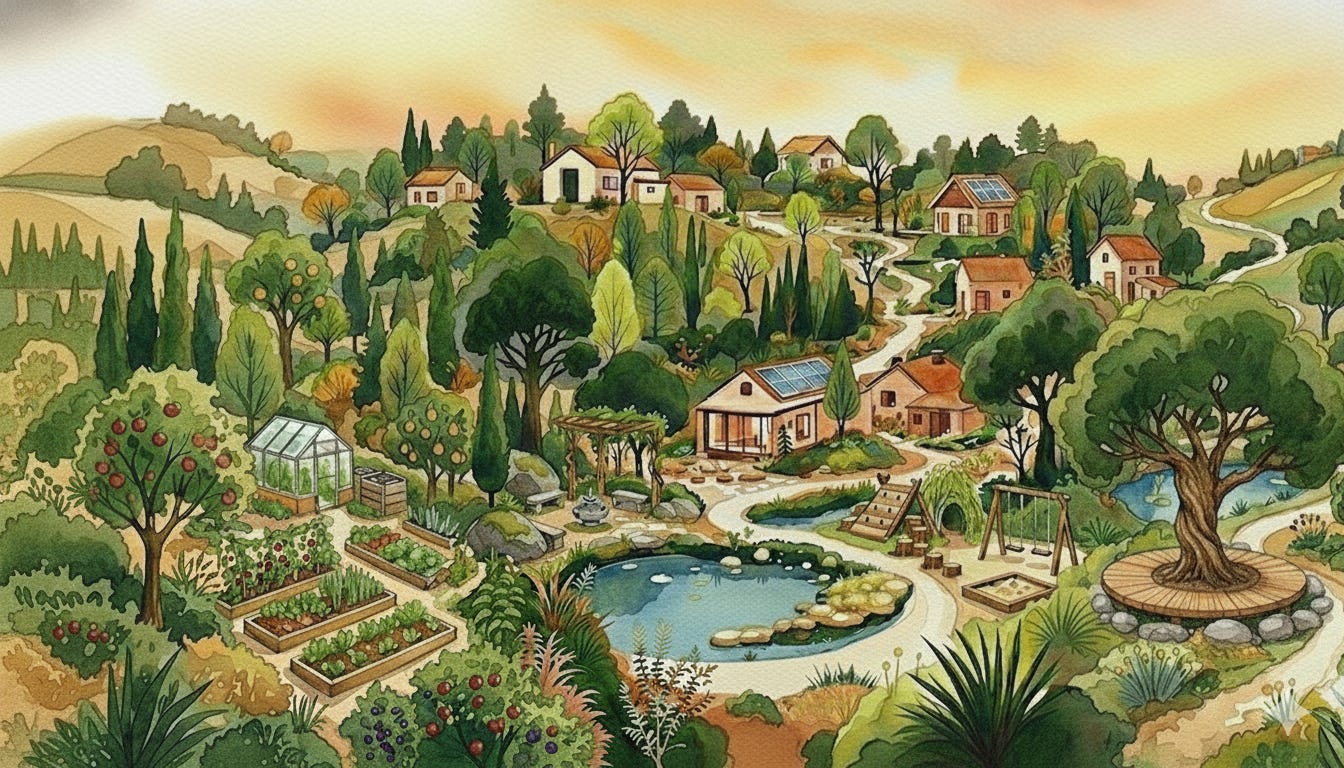
Before we get started, given all the hype around AI, here’s what Nano Banana thinks about Kaanan Kul.
4th December 2025, 7:59 am marked a small but meaningful milestone for Kaanan Kul, a concept we introduced in our first post.
One month ago, we released Kaanan Kul’s first prospectus with an invitation to be a part of our seed community. We feel honoured, privileged, and perhaps even a little bit amazed to have officially hit the 50% mark of our seed community funding goal this quickly. This isn’t just families saying “I’m interested” or verbally committing to the goal, it’s the founding families putting capital behind a common cause.
We want to take a moment to really appreciate every member of the seed community and acknowledge their ability to be decisive in an uncertain world. There is no denying that the idea for Kaanan Kul is uniquely ambitious and depending upon which side of the fence you are on, it’s either visionary or quixotic. We have deep empathy for the fact that being a part of Kaanan Kul has required each member to surpass so many well-known barriers to decision-making:
It’s easy to like an idea, but so difficult to back it up with investment. As with most idealistic endeavors, generating interest is the easier part. It’s during the follow through, in the form of either time or effort or money from stakeholders, when the ideas fizzle out. Our brains immediately start thinking about short-term tradeoffs. When we can’t see short-term gains, our resolve starts to waver. Our early backers were able to take a longer-term view with their investment.
It’s hard to define what we want 5–10 years into the future. Most of us can’t predict what life will look like one year from now, imagine how daunting it must feel to buy into something you may want 5–10 years later. The seed community was able to distill the core principles of Kaanan Kul from our prospectus and really assess if those tenets resonate with them at a fundamental level. They were able to conclude that while their wants may keep evolving over time, their fundamental values and the needs arising from those are less likely to change. To that end, it made sense to apportion a small part of their life force into building a future that nurtures those fundamental needs.
We struggle to back concepts, the human mind needs tangibles. We all have some practice operating as investors, where we can evaluate tangible assets. From buying stocks to commodities like gold, or even an apartment in a city — these are “safe” assets that have perceived value in society’s collective imagination. On the other hand, with Kaanan Kul, while we will eventually have an underlying land asset, as of today, all we have is a concept and a shortlist of land parcels that are conducive to our concept. The seed community built conviction on the basis of the work that has gone into defining the concept, with food forests, farms, sustainable homes, community living and the preliminary due diligence to prospect (and eliminate) more than 40 land parcels in the Sindhudurg region.
Seeking out pioneers who will surpass such barriers was a deliberate design decision in our process. To put things in perspective, Kaanan Kul has a five-year process starting from ideation to having some families reside within its embrace.
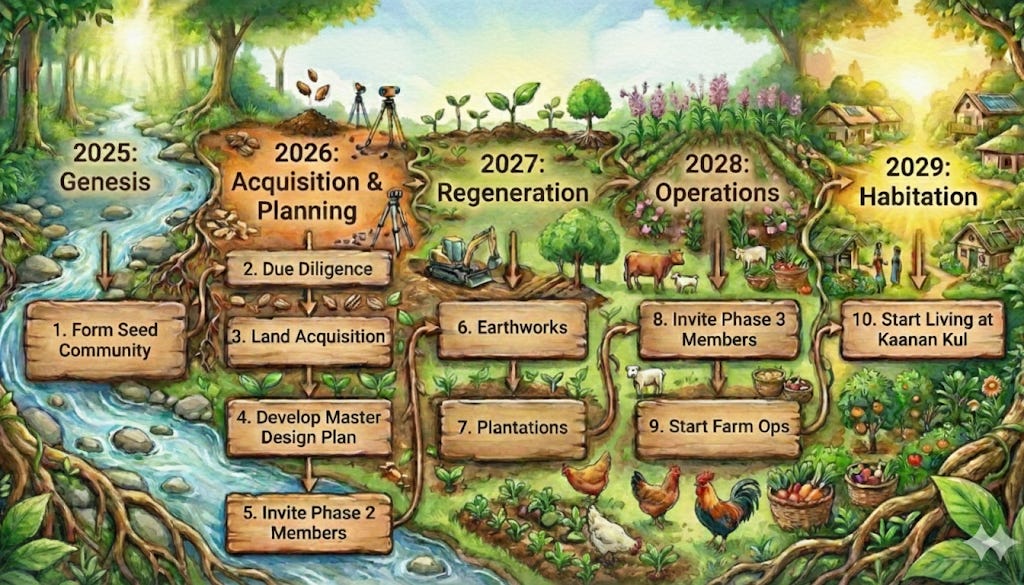
As we see above, forming the seed community is the first and, in our view, the most crucial step. Many of our well-wishers had questions about this sequence, especially when there exist, potentially easier paths to raising capital. While the long list of FAQs is indeed quite long, we would like to highlight three common questions and our responses that convey our thinking behind our approach to capital.
“Why did you choose this sequence? In a typical real estate purchase, buyers see the land and assess it before committing to it. Why not follow the same process here?”
The simple answer is that this isn’t a typical real estate purchase.
Practically speaking, we wanted the seed community to be stewards of the land and build a connection with it from the get-go. This means that they get to vicariously experience the extensive due diligence process of land buying. Moreover, this process has a non-trivial cost, rightfully borne by the community. We also believe this gives them more agency in defining and contributing to the mission. They’re not just buying into a preset vision, they are active contributors to it, exactly as we outlined in our first post. As a corollary, this also implies that the seed community is able to partake at a lower cost than the true cost of total development.“Wouldn’t it be easier to get financiers to purchase the land and fund development? You could subsequently flip it to people who may want to stay here at a premium.”
This is the typical builder–buyer model and absolutely, it would have been WAY easier. It would also have run contrary to everything we stand for.
For starters, not a single stakeholder within Kaanan Kul is doing this primarily for economic gain — like investors and financiers might. Conventionally, investors prioritise profit over principles. What we want, what we need, is intentional capital from stakeholders who want to physically manifest their ideals within Kaanan Kul. They’re not looking for an exit opportunity or interest on a loan. They want to see themselves and their loved ones benefit directly by sowing the future they have envisioned.“Well, there’s a swathe of social impact investors who can provide intentional capital too, why not access that?”
It’s true that for these investors, profit isn’t the sole motive and they’re very happy to see modest returns as long as the capital achieves certain goals — in this case, rewilding, rejuvenation and regeneration. However, this too, was an easy one for us to say no to.
We have often called Kaanan Kul Ekam a proof of concept — a POC. We need to prove that this concept can be gestated by a coalition of believers. Families that believe in their end use and therefore continued patronage of this land. The true success of this POC is when many other communities can build conviction in the viability of the concept. They may not have access to bank loans, and investors, let alone social impact investors. All they need is fewer than ten founding families at an affordable contribution and at least one among them willing to put in the effort on the ground, to get started.
We hope it’s evident that even our micro-decisions have been geared towards being community-funded, community-owned, and for community-benefit. Achieving our partial milestone in the short time that we did, has only reinforced our belief that we should continue to work towards long-term outcomes instead of optimising for any short-term milestone. With our glass now half full, here’s to filling our cup with a renewed sense of gratitude and purpose.
We were recently reminded to cherish and celebrate every small step and success that comes our way. So, as a token of our appreciation to our community and the 30+ other families who are currently in discussions with us to be a part of this collective vision, we dedicate our next post towards providing a visual reference to our vision.
A special note to those who are intrigued by the vision but are yet uncertain if this is right for them:
We are on a mission to make sustainable living accessible to everyday families. This means doing whatever we can to
make this idea affordable to your present-day context
relevant to the needs of your loved ones and
worry-free for your peace of mind
We believe that having candid, open conversations is key to achieving that. While the seed community has a limited capacity, there will be a few more opportunities to be a part of Kaanan Kul in the future.
We do not want any prospective member to have to take a decision under a time pressure or ever be at the receiving end of a sales pitch. I invite you to reach out and let’s talk about what we can create together.
To read more about Kaanan Kul —
Awaken

For a few years now, I have felt an idea take root within me. What may have started out as a simple desire to live closer to the natural world, has evolved into a calling to also actively give back to it. I no longer wish to be just a passive observer or consumer, but an active contributor, in creating and shaping a new way of life. This is the inspirat…